Thursday, 22 September 2011

Nuclear Generators Go Green

0 comments Posted by Usama.Alvi at 00:51
Nuclear power from reactors nudges enriched uranium into a critical mass that unless controlled can create a chain reaction that produces dangerous radioactive byproducts that must be kept safe from humans for thousands of years. Nuclear-powered laser-turbine electricity generators, on the other hand, harness the harmless radiation from the natural decay of thorium--an abundant natural ore.
"Our device is not a reactor," said Charles Stevens, founder of Laser Power Systems LLC, who has become sensitive to people calling his device a reactor. "Our device is a laser-turbine electricity generator that uses sub-critical thorium as its power source."


Cadillac hypothesized that a thorium fueled power plant in this concept car could carry enough fuel when manufactured to power it for its entire lifetime. (SOURCE: Cadillac)

Stevens started his research circa 1984 when he invented a laser that could be powered by rare earth metals. Over the years his research has worked its way up the periodic table to demonstrate how heavier and heavier atoms can produce lasers of increasingly greater power. Eventually LPS perfected a uranium-powered laser that produced their highest power yet.  However, three-years ago Stevens decided to "go green" and throttle back from dangerously radioactive materials to thorium, which he claims is a safe source of nuclear power.
"Thorium can be use to power a laser that creates temperatures in excess of 3000 degrees," said Stevens. "We use it to heat water, which makes steam to drive a turbine that turns a generator to create electricity."
LPS currently has several prototypes of its thorium-powered laser-turbine generator. A 5 kilowatt unit is for general portable use, but its 250 kilowatt unit could substitute for an automobile engine. The automobile engine sized unit measures just 12-by-12-by-26 inches, weighs 500 pounds, and can produce the equivalent of about 335 horsepower. In addition, an electric automobile powered by thorium could be delivered with enough fuel to last its entire lifetime, since about one gram of thorium is the equivalent of about 7500 gallons of gasoline, and 8 grams of thorium could power a typical car for over 300,000 miles. LPS also has a 2.5 megawatt unit on the drawing board that could power about 5,000 homes with a unit about the size of a refrigerator.
LPS's proprietary thorium-fueled laser-turbine electricity generators, which are protected by 20 patents, use a Tesla coil to drive a spark-plug-like device which accelerates the natural decay of thorium. The emitted alpha- and beta-particles are used by proprietary electronics to stimulate a gas laser into emission in a sub-critical reaction that never emits dangerous radiation like gamma-rays.
According to Stevens, thorium is four to five times more abundant than uranium, with known worldwide resources available that could power everything on the planet for about 5000 years. After that, the Moon has massive deposits of thorium which NASA has already mapped, and which could be scooped up from the surface without the need for convention deep-mining equipment.
Read More »

Tuesday, 20 September 2011

New Skills robot QBO

0 comments Posted by Usama.Alvi at 00:31

Robot QBO has been known for several years and during that time is constantly evolving. Now he has learned to recognize gestures with his stereoscopic vision, which allows you to manage a playlist. QBO is running Linux.


Read More »

Bag Electric

0 comments Posted by Usama.Alvi at 00:26
ThinkGeek company known for its series of original music t-shirts on which to play. Among the simulated musical instruments: guitar, synthesizer and drums. Shirts come in various sizes, suitable for both adults and children. Wanting to give the idea of ​​an extraordinary new stage of development, ThinkGeek decided to release yet another musical product. The novelty is equipped with the same analog electric guitar, which previously could be seen on the very first T-shirt series. To play music in your bag has a small amplifier, which is attached to the valve. Invited to play guitar exactly the way that that is the case with T-shirt. Painted on the fretboard you can even take these chords. To use a guitar amplifier and requires four AAA batteries. As for the bag itself, then it is placed in a 17-inch laptop or a similar-sized objects. To store various things in the new product, there are two large offices, six small, and a special pocket for your mobile. The cost of this “gadget” is only $ 50.
Read More »

What to Do With a New PC

0 comments Posted by Usama.Alvi at 00:24

Here's how to eliminate crapware, install all of your favorite apps at once, and get your brand-new PC ready for hard work (or play).

 Everyone has their own I-just-bought-a-new-PC ritual. Some folks start by loading their pristine PC down with all their utilities and apps. Others immediately jump into the new games their old machine couldn't handle. A few others install Linux.What to Do With a New PC

That’s all well and good--but before doing any of those things, you should take a few important steps. Prior to diving headfirst into your new laptop or desktop, read our favorite new-PC tips and tricks, all of which are designed to keep your system feeling brand-new for as long as possible.

Step 1: Update Windows

What to Do With a New PC: Update WindowsAfter you're done pulling the plastic off your new PC and plugging it in, the first thing you should do is grab all the Windows updates your new machine can handle. Of course, you'll need a network connection for that; just link your PC to your modem or router by inserting an ethernet cable, or if your PC supports Wi-Fi and you have a Wi-Fi network, open the Control Panel, go to Network and Sharing Center, and click Connect to a network.
Once you’re connected to the Internet, go to the Control Panel, choose Windows Update, and click Check for updates to make sure Windows Update pulls in as many updates as possible.
Depending on how long your PC was sitting on a store shelf without an Internet connection, this process could take anywhere from a few minutes to more than an hour. Each update may require a reboot, and some updates prompt even more: You'll probably have to grab updates, reboot, and check Windows Update again for updates to those updates you just installed.
Unfortunately, we can't do much to help you speed up this step. However, you may want to read our tutorial about slipstreaming Windows 7 updates on a USB drive, which eliminates the need to download updates over and over. Placing the latest updates on a USB drive lets you install the latest Windows 7 updates as you run the Windows 7 installation disc. It’s especially useful if you're the administrator for a few PCs on your home or office network, as it cuts down the time needed to download and install updates on each machine.

Step 2: Uninstall the Crapware

SlimComputer uses a crowd-sourced database to recommend which apps you should install and which apps you should keep--but the recommendations aren't always useful.SlimComputer uses a crowd-sourced database to recommend which apps you should install and which apps you should keep--but the recommendations aren't always useful.Unless you built your PC yourself, it likely came with a whole bunch of preinstalled apps and utilities. Many of these are undoubtedly well-intentioned inclusions--and some might even be useful--but you don't have to hang on to your 30-day Norton AntiVirus trial if you know that you're just going to use Microsoft Security Essentials instead.
If you know exactly what to keep and what to get rid of, a deep uninstaller utility such as Revo Uninstaller is all you need. The free, basic version scans your system to ensure that it eliminates applications that Windows' built-in uninstaller sometimes misses.
However, determining what's crapware and what's worthwhile isn't always easy. PC Decrapifier does a good job of identifying a lot of the common crapware culprits--toolbars, trial-application installers, shortcuts for setting up old dial-up services, and so on. You get to review the list of recommended items to uninstall before you pull the trigger, so you don't need to worry about accidentally losing something you want to keep.
Alternatively, you could give SlimComputer a shot. Like PC Decrapifier, SlimComputer aims to take out the junk, but it uses feedback from other SlimComputer users to make recommendations and provide brief notes as to why a program may or may not be useful. As always, we’d balance out a lot of the user-supplied comments with a healthy dose of common sense, but they are a helpful point of reference for any applications you're on the fence about.

Step 3: Update the Drivers

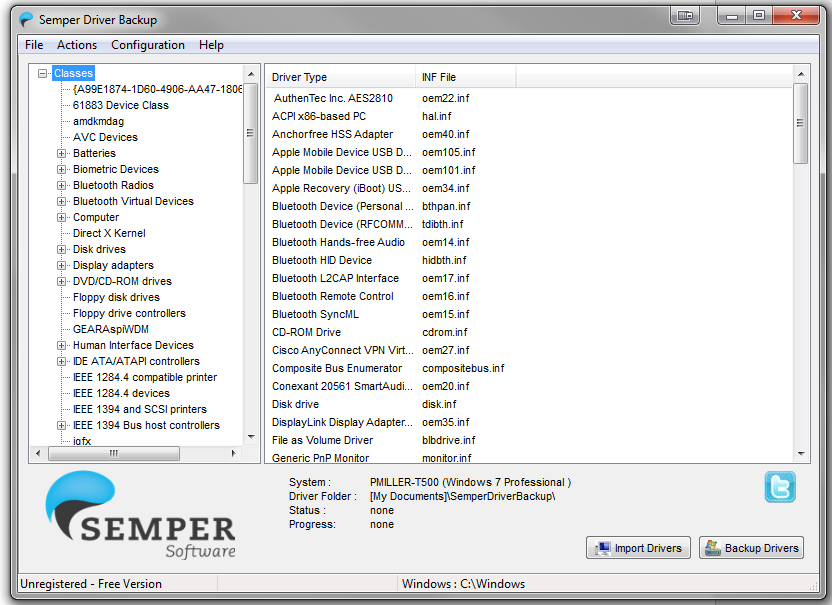
Semper Driver Backup can create a library of your drivers and back it up.Semper Driver Backup can create a library of your drivers and back it up.The drivers are what turn the collection of parts in your PC from a generic Windows-running box into a processing powerhouse. Your ideal driver setup, though, depends in part on your PC's configuration--and on your tolerance for risk.
Generally speaking, you want to have the newest drivers available for all your gear. For example, making sure your graphics card's drivers are up-to-date will usually fix bugs and enhance performance with each new revision, and you might not be able to perform basic functions such as networking or audio input/output without your motherboard's full set of current drivers. If you're still having problems getting certain devices to work, updating the BIOS might be in order.
If you stick around the PC scene long enough, however, you’ll inevitably come across a driver update that breaks something that used to work perfectly. That's why some people prefer to stay with whatever driver version works for them--and leave it at that until something doesn't work. Short of clinging to an older, working driver, you can fix many driver-related problems by rolling back to a previous driver version, or you can uninstall the updated drivers and reinstall (from scratch) a version that worked fine.
If you're on a new, store-bought Windows 7 PC and all of the component drivers are preinstalled, you're probably better off with the existing drivers (though you may want to check for BIOS and graphics-card driver updates for the performance benefits anyway). Also, you don't necessarily need to worry about finding drivers for everything on your PC: Windows has generic drivers available for USB drives, keyboards, mice, webcams, and so on.
On the other hand, if you're breaking in a PC that you made yourself, we recommend updating everything to the latest stable drivers available. If things aren't working seamlessly after that, find out whether the component manufacturer offers a beta driver that works better.
Once all your drivers are in working order, you'll probably never want to deal with this stuff ever again, so grab a driver-backup tool such as Semper Driver Backup or Double Driver. These tools make a quick copy of all your current drivers, so you can easily restore the drivers if (or when) something goes wrong.

Step 4: Install Everything at Once

Ninite lets you batch-install and update dozens of common useful Windows apps.Ninite lets you batch-install and update dozens of common useful Windows apps.By this point you're probably itching to install the applications and utilities you've grown accustomed to using on your previous machines. The hard part is remembering every single application you use--probably not difficult for those you work in on a daily basis, but a bit harder for the ones you touch only every week or month or so--and spending the time to seek out and download each and every one of them.
When it comes to tools that can help with this monumental task, we can't sing Ninite's praises enough. Head to that site, and you can view a huge catalog of common free apps--Web browsers, antivirus utilities, file-sharing and media-playback programs, and so on--and get them all bundled in one installer file. You just choose the software you want, download the custom installer, and download everything in one fell swoop. Ninite even selects the 32-bit or 64-bit version as appropriate for your PC, and it skips all the adware and toolbars that, ordinarily, you might install by accident while clicking Next over and over.
One more tip: Resist the urge to delete Ninite's installer once it's done working its magic. If you run it after you've already installed all of your apps, it will check for any updates and automatically download and install the ones you need.

Step 5: Disaster-Proof Your PC

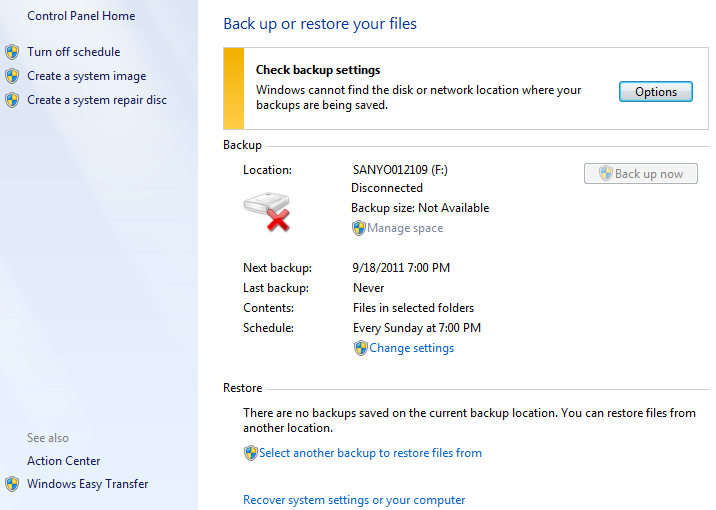
Windows Backup is a free, basic backup tool built into Windows 7.Windows Backup is a free, basic backup tool built into Windows 7.Congratulations! By now, your PC should be primed for action, just the way you like it. Get out of your seat and stretch for a minute. Then sit back down--you still need to do two things before the system is fully prepared for everyday use. You don't want to have to repeat this whole process if something goes wrong with your hardware or Windows installation, so this step will create a sort of “reset button” that brings your PC back to its ultimate state.
Take a moment to preserve your machine's pristine, work-ready existence with Macrium Reflect Free, which creates an image backup of your hard drive that you save to a backup drive. If anything terrible happens during your computing adventures, you can just restore the system from this image backup.
You should probably also set up an automated backup system if you haven't already. If you pay $40 for the Pro version of Macrium Reflect, it adds automatic incremental backups to that same image file; you won’t have to create a new one each time.
If you'd rather save the cash, you can use Windows 7's built-in Backup and Restore features instead. To do so, open the Control Panel, click Backup and Restore, and adjust the basic backup settings (location, frequency, backup directories, and the like). For more tips on disaster-proofing your PC, read Rick Broida's "Prepare Your PC for Future Data Disasters."
If you've read this far and followed all the steps, your new PC is now plenty prepared for the future. It’s time to take your new machine for a spin!
Read More »

iPad 3 in '11? No. Two new iPhones

0 comments Posted by Usama.Alvi at 00:08
Just weeks away from when Apple is expected to be unveiling the next iPhone, another Wall Street analyst has said the company could surprise us with two new handsets.
iPhone 4Fortune this morning posted part of note from J.P. Morgan analyst Mark Moskowitz saying that the firm expects Apple to release two new iPhones: one that will be a brand new model with a different appearance, and a souped up iPhone 4 model called the "iPhone 4-plus."
"Our research indicates that there will be an iPhone 5 based on a lighter, thinner form factor that is GSM + CDMA capable, i.e., a 'world-mode' smartphone. A second device (4-plus) based on the current iPhone 4 but with some minor improvements could target the midrange and focus on China," Moskowitz wrote. "As for the current iPhone 4, we expect it to subsume 3GS as the lower-end offering."
Moskowitz also weighs in on rumors of Apple considering the release of a third-generation iPad before year's end, saying Apple's in "no rush" to replace its existing models based on lackluster competition.
"The other tablet entrants have stumbled," Moskowitz wrote. "Offerings by MMI and RIM have been the latest disappointments. Also, we had the opportunity to demo Sony's tablet before its launch. We were not impressed."
Reports earlier this year claimed Apple was gunning to release a new model of the iPad in time for the holiday shopping season. A tech blog called This is my next claimed in July that Apple was working on a special HD model that would be sold alongside the iPad 2. Taiwan-based news site DigiTimes followed, saying Apple was cooking up a thinner iPad model with an improved display, called the "iPad 2 Plus." Not to be outdone, the Taiwan Economic News said a new iPad model would be ready by Thanksgiving.
In August, things started looking bad for those rumors though. Two analysts told CNET that a new iPad wouldn't be ready until next year because its high-resolution display was difficult to make in the volume Apple needed. Mobile processor industry tracking firm the Linley Group also said Apple's next-generation, four-core A6 processor would not be ready until the middle of 2012, meaning a new device would have to use the same processors in the current iPad 2 model.
As for two new iPhones, this is not the first such suggestion that Apple plans do so, something that would be a first for the company. A Deutsche Bank analyst in June said that Apple was working on a similar configuration of a high-end new model, and improved iPhone 4 model for release this year. Evidence suggesting that might be the case surfaced a few days later, with a screenshot of a white plastic iPhone 4 model on Vietnamese site Tinhte--the same outlet that got ahold of the iPhone 4 ahead of its official unveiling.
More recently, there have been murmurs of two iPhone model offerings as part of deals being worked out with Chinese carriers, which are expected to carry the new iPhone when it's released. Moskowitz highlights China and its potentially massive subscriber base as one of the main reasons for offering a lower cost iPhone 4-plus model, but that he does not expect it to be exclusive to the region.
Apple is expected to release its next iPhone model in October, with a possible unveiling of the device later this month.

Read More »

Sunday, 11 September 2011

AT&T To Release Sony Ericsson Xperia Play 4G On September 18th

0 comments Posted by Usama.Alvi at 00:32
Sony-Ericsson-Xperia-Play-4G
AT&T is reportedly planning on releasing the new Sony Ericsson Xperia Play 4G on their network starting on September 18th. The handset is said to retail for just $49.99 with a new 2-year contract agreement. Coming in a midnight blue shade, the handset offers a 4.0-inch 854 x 480 touchscreen display, a 1GHz processor, a VGA front-facing camera, a 5.0-megapixel rear-facing camera, a PSP-styled keyboard, PlayStation games, HSPA+ support and runs on Android 2.3.3 Gingerbread OS. [Press Release]
Read More »

Pioneer STEEZ Portable DAP

0 comments Posted by Usama.Alvi at 00:31
Pioneer STEEZ Portable DAP
If you are looking for a new Digital Audio Player(DAP), then check out the Pioneer STEEZ Portable (NSP-D10P). Measuring 39.8mm x 86.8mm x 15.5mm and weighing 55 grams, the gadget provides a 4GB of storage space, an OLED display, and a mini USB port. There is also a “Non-Stop Mix” function, which will automatically select and play music tracks that comes with a similar tempo. The DAP is compatible with MP3, WMA, AAC and WAV files. The Pioneer STEEZ Portable DAP will be released in Japan next month. No word yet on pricing. [Pioneer]
Read More »

BenQ R70 Android Tablet Released In Taiwan

0 comments Posted by Usama.Alvi at 00:25
BenQ-R70-Android-Tablet
BenQ has released a new Android tablet in Taiwan called the R70. The device comes with a 7.0-inch 800 x 600 LED-backlit multi-touch display, a 1GHz Cortex-A8 processor, a 2GB RAM, a microSD card slot, WiFi, Bluetooth 2.1, built-in stereo speakers, a mini USB 2.0 port, an HDMI port, a 3.5mm headset jack, a 4,400mAh battery and runs on Android 2.2 Froyo OS. The R70 sells for about $308. [BenQ]
Read More »

Tuesday, 9 August 2011

Wet Electronics Open Door to New Possibilities

0 comments Posted by Usama.Alvi at 03:55
Twice I ran my old Sony-Ericsson cell phone through the washing machine and it miraculously survived, but that is only a testimonial to device's excellent waterproofing technologies. That all may change soon, when ultra-secure moisture-friendly prototypes recently shown by North Carolina State University (NCSU) are commercialized.
Today, electronic devices of all types must be protected from not only submersion in water, but even from humidity in the air. Medical implants, for instance, must be hermetically sealed to secure them from shorting out. By harnessing the synergy between water-compatible hydrogels and liquid metals, NCSU researchers herald a new era of smarter moisture-compatible electronic devices.
  A 2-by-2 array of crossbar switches where memory-resistors at each crossing operate like synapses in the brain. (Source: NCSU)
As you might imagine, materials that can happily be submerged without dissolving or shorting out their circuitry are few and far between. And those that can—such as plastics—have inferior electrical characteristics, making them too slow reacting for medical implants and other mission-critical electronics that must work rain or shine. However, by combining liquid metals with polyelectrolyte hydrogels, which have the consistency of Jell-O, a new class of fast submersible gadgets is on the horizon.
The key to this invention of NCSU professor Michael Dickey, however, is not the water compatibility of the materials themselves, but rather the ability of the metal—an eutectic alloy of gallium and indium—to form a nonconductive oxide skin when current flows through it. The switches can be programmed to act like synapses in the brain. In effect, these crossbar switches remember their "experiences"—an effect called a memory-resistor, or memristor, by their inventor, University of California at Berkeley professor Leon Chua (this technology is currently being commercialized by HP Labs and Hynix).
Consequently, the new liquid-metal/hydrogel combination can be used to create brainlike circuitry that learns from its environment. The first task of these new water-compatible circuits, however, will be much less ambitious, since for one thing they are still being built on the millimeter scale rather than the micron- and nano-scale of circuitry in the brain. However, simple circuitry can be realized with the new approach to create biological sensors that can be directly implanted for medical monitoring.
NCSU doctoral candidates Hyung-Jun Koo and Ju-Hee So also contributed to the work, which was funded by the National Science Foundation and the U.S. Department of Energy.
R. Colin Johnson has been writing non-stop daily stories about next-generation electronics and related technologies for 20+ years. His unique perspective has prompted coverage of his articles by a diverse range of major media outlets—from the ultra-liberal National Public Radio to the ultra-conservative Rush Limbaugh Show.
Read More »

Data Furnaces Use Servers to Heat the Home

0 comments Posted by Usama.Alvi at 03:54
A recent paper by Microsoft Research suggests using servers and data centers to heat buildings, including homes, offices, and college campuses. The method could cut the costs and energy waste traditionally associated with big server farms.

Massive server farms are becoming more and more common. While we frequently advocate the business benefits of the cloud here at Smarter Technology, the environmental consequences of the numbers of servers needed for major cloud efforts can be huge. A recent paper now proposes an unlikely solution to this environmental problem: using servers as furnaces to heat homes, offices and other buildings.
According to the Environmental Protection Agency, servers and data centers are responsible for up to 1.5 percent of electricity consumption, much of which is used trying to keep the machines cool. While the machines don’t generate enough heat to produce electricity, their temperature (which reaches up to 122 degrees) is perfect for heating purposes, including water heating and clothes dryers.
Big server farms are a major consumer of electricity in the United States. Using their heat to warm homes and offices could cut costs and save energy.

The paper by Microsoft Research proposes using micro-datacenters as “Data Furnaces,” the primary heating sources for office buildings and homes. Each Data Furnace, consisting of 40 to 400 CPUs, would integrate with the existing infrastructure of a building, much like a traditional furnace.
The researchers suggest that cloud-computing service operators could offer free heating to the companies and families housing the Data Furnaces. The technology could thereby diminish costs for both parties, as well as reduce energy consumption.
One disadvantage of the system is the lack of security in residential areas and even office buildings, according to a recent article in Gizmag. With encrypted data and tamper-proof devices, however, the Data Furnaces could avoid breaches.
The researchers suggest that Data Furnaces could save companies up to $324 per furnace per year. “Data Furnaces will reuse the facilities and energy already allocated for heating purposes to provide computing services with low cost and energy footprint,” they write.
“A similar approach could be used to heat water tanks, office buildings, apartment complexes, vegetable farms and large campuses with central facilities,” the researchers add.
Would you consider using servers as furnaces in your home or office? Let us know in the comments section below!

Read More »

Lose your laptop? Change all passwords, pronto

0 comments Posted by Usama.Alvi at 01:49
Elie Bursztein, left, highlights Windows password vulnerabilities during a Black Hat talk.
(Credit: Declan McCullagh/CNET)
LAS VEGAS--If your Windows laptop is stolen, be warned: new research shows how a thief can gain access to the passwords used by your Amazon.com, Google, Yahoo, Facebook, and other Web accounts.
The passwords for accounts in the cloud are supposed to be protected by Windows' built-in encryption. But a team of security researchers demonstrated at the Black Hat security conference here how last week to bypass the operating system's security.
A thief--or someone unconcerned with the finer points of federal hacking laws--can take advantage of the vulnerability to discover the passwords stored by Web browsers and other programs like instant messaging clients. So can police using electronic forensics to analyze a computer seized during a criminal investigation or without a warrant at a national border.
"It's not just your data on the computer, but everything you have in the cloud, including your Facebook account, your Gmail account, and so on," Elie Bursztein, a postdoctoral researcher at Stanford University who also analyzed Microsoft's geolocation database, told CNET. Ivan Fontarensky, Matthieu Martin, and Jean Michel Picod collaborated with him on the research.
The team has released a open-source utility to perform this decryption, which they call OWADE, for Offline Windows Analyzer and Data Extractor. It runs on Ubuntu, a Debian-derived Linux distribution, and is designed to decrypt information stored by the four major Web browsers and instant messaging clients under Windows XP.
Here's how it works: Windows offers a built-in encryption feature called DPAPI, part of the Crypto API, which allows application developers to store sensitive data in scrambled form. Microsoft describes as allowing any application to "secure data without needing any specific cryptographic code other than the necessary function calls to DPAPI." (API stands for application programming interface.)
That's a useful feature to have--assuming it's designed and implemented well.
What Bursztein and his colleagues found are security vulnerabilities in the way DPAPI was created. For instance, the list of possible passwords in many versions of Windows is unusually small, about 7 trillion possibilities, and can be pre-computed.
A Microsoft representative said the company would have a public response later today.
Another vulnerability they found is in the way passwords for Wi-Fi networks are encrypted and stored. (In Windows XP, they're in the system registry. In Windows 7 and Vista, they're in both the registry and an XML file.)
Different browsers, they found, store passwords for Web sites in different locations with varying amounts of security precautions.
"I'm very sad to say that Firefox is the worst for offline security," said Bursztein, who uses that browser himself.
Internet Explorer turns out to be the most secure. If you don't know the exact Web page, you can't recover the password.
Instant messaging clients also offer differing levels of security. They found Skype uses custom encryption for passwords and rated the difficulty of decrypting or bypassing it as "extreme." If the Skype password is sufficiently strong, they said, it can't be discovered.
Google Talk's Windows client uses DPAPI and is rated as "hard" to penetrate. Microsoft Messenger gets a verdict of only "medium," with details varying based on which version is being used.
Even worse: aMSN, an open-source MSN Messenger clone; 9talk; Trillian; and Pidgin.
Bursztein's recommendation, after doing all this work? "The mechanism that's in place in Windows to protect your data can be easily bypassed. The only real alternative for you is to encrypt your disk if you don't what your account compromised."

Read More »

Hacker launches volunteer program for security professionals

0 comments Posted by Usama.Alvi at 01:43
Renowned hacker Johnny Long drums up support for his Hackers for Charity nonprofit and announces a new InfoSec without Borders program at DefCon.
(Credit: Seth Rosenblatt/CNET)
LAS VEGAS--Johnny Long used to be known for Google hacking--finding vulnerable servers on the Internet using specific search terms. Now he's helping humanitarian groups, street kids, and police in Uganda learn how to use computers and keep malicious hackers out of their systems, as well as matching other information security professionals to charities that need help.
Long, who started the Hackers for Charity nonprofit in 2008, launched a new program at the DefCon hacker conference here this weekend that he's calling InfoSec without Borders and which is modeled after the Doctors Without Borders program.
"The volunteers are professionals in the industry now and they have a corporate responsibility" and want to help communities in need, he said. "We want to help guide that by feeding in charities that we screen."
Long's nonprofit provides free computer training to anyone who wants it, fixes computers, provides technical support to nongovernmental organizations (NGOs), and has fed thousands of families through its "food for work" program.
"We've trained street kids, the Ugandan police, government officials, Red Cross workers. We're trying to raise the level of technical ability to provide not only a service, but jobs," he said in an interview yesterday. "We have given computer training to lots of people who had absolutely no background in it. Now they have jobs and are doing things like word processing, office reception...and that kind of work is very well paid because the pool of resources there is so small."
Hackers for Charity has 30 employees and thousands of volunteers all over the world. "We've been fully embraced by the hacker community," he said, adding that the majority of the group's funding comes from hackers.
For many people, the word "hacker" conjures up images of underground criminals who break into databases and steal credit card data or the Anonymous and LulzSec groups that are really online activists described by veteran hackers as "script kiddies" who use automated tools and other less sophisticated techniques to find and exploit holes in software. But a true hacker is driven by intellectual curiosity and a challenge and has a desire to master technology and find new uses for it.
In Uganda, there's a new definition as a result of Long's work.
"The definition of 'hacker' in areas we work in Uganda has changed to 'aid worker,'" Long said. "They don't have the idea that hackers are criminals. They see us as computer wizard aid workers. That's one of the underlying things I wanted to accomplish with Hackers for Charity, to change the perception. We had been labeled as a criminal community and it's not fair."
In the 1990s, Long worked at Computer Sciences Corporation and created its Strike Force vulnerability assessment team. While there he specialized in using Google to find servers that are vulnerable to attack, sites exposing sensitive data like Social Security numbers and passwords and other things companies wouldn't want accessible via a search engine query.
After his wife went on a mission (they are both Christians) to Uganda in 2006 and shared what she had seen, Long went there and did volunteer computer repair work for an NGO whose virus-laden computer system was "a mess" and was hindering the organization's ability to keep track of contributions and be productive.
"The impact was immediate. The NGO was on the ground and up and running in two weeks, and feeding children the day we left. The last thing they said to us was 'you saved lives,'" he said. "That absolutely struck me and when I got back to the real world it was all I could think about. I wanted to use that platform to get people plugged in to that feeling of doing something positive, and to offer a positive path for hackers."
"It's hactivism by definition," Long said. "It's using technology to create social change, but it's the first example of positive hactivism I've seen."
Asked if people participating in online activism organized by the Anonymous group were hactivists, Long said: "It depends on the results of what they're doing. With Sony's site going down, you can see the immediate effect of their actions. But as to the social change, the political influence that they have, how do you measure that? A successful hactivist will be able to measure both. Personally, I have trouble seeing that impact."
Hackers for Charity is based in Jinja, which is a "stone's throw from the source of the Nile" and the second largest town in Uganda. Long's family runs a restaurant catering to Western tastes of tourists who might want a change from the typical fare of goat milk and rice. Visitors "will have a milkshake and cheeseburger and they'll drop off their laptop for a $20 repair," he said.
A lot of people are poor and turn to crime to survive. Long's family--including his three children ranging in age from nine to 15--live in a gated compound with barbed wire and an armed guard. "We have bars on every window and gates on every door," he said.
Most of the crime in Uganda is theft, he said. Computer security is practically non-existent, and that combined with the poverty is driving criminals online, according to Long, who is helping educate the Ugandan police on how to investigate everything from financial and bank fraud to credit card skimming and online scams.
"Criminals see this as a sand box to play in," he said. In addition to the work Hackers for Charity does, Long also works teaching the police about information security and connecting them to experts in the U.S. "It's basic training with the police there that can lead to training in things like forensics, he said. "We can work on cases, but we're also bringing up a generation of cyber cops in a place that has almost no infrastructure. It's unique."
Long is worried that Uganda could become another Nigeria, which is known in the online world as the birthplace of the Nigerian scam or "advance fee fraud," which features e-mails from a "barrister" who claims to be unable to access a large sum of unclaimed money without access to a bank account in a western country and offers a percentage of the money for help. By offering free computer training and other help Long hopes to help break the cycle of poverty without people having to become online thieves.
"If something doesn't change Uganda will become another Nigeria in the sense that criminals will take advantage of the technology first," he said. "We're trying to head that off as best we can."

Read More »

Saturday, 6 August 2011

Top 5 Potential Cyber-Enemies for the United States

0 comments Posted by Usama.Alvi at 00:38
Details of "Operation Shady RAT"--a years-long campaign of hacking and cyber-espionage that's targeted the U.S. government, the U.N., the International Olympic Committee, and numerous other agencies and corporations worldwide--were released by security firm McAfee this week.
So far, most of the evidence gathered seems to point to China as the likely perpetrator behind Shady RAT, which is McAfee’s name for the operation. But the U.S. and the West also have other potential cyber-enemies to be wary of. Here's a breakdown of the five most likely parties with the resources and the will to carry out similar campaigns.

China

Easily the most significant cyber-threat. Not only are Chinese hackers suspected to be behind Operation RAT, but they're also the likely perpetrators of earlier hack attacks against Google and other incidents in recent years. The political value of the targets, including some in Taiwan, would also seem to indicate at least some level of tacit knowledge of the hacking activities by the Chinese government, if not full-blown support. If that's the case, then Chinese government-sponsored hacking represents by far the greatest cyberwar threat, given the nearly limitless resources China's ruling Communist party has been known to throw into pet projects.

Anonymous/Hacktivists

McAfee says that by comparison to what it uncovered in Operation Shady RAT, the Anonymous/Lulzsec brand of hacking is "just nuisance." So far, the hacker collectives have limited their activities largely to defacing websites and leaking embarrassing or private information. They also claim to have retrieved a number of files from a NATO server that they said they would not release because it would "be irresponsible" to do so. Ethical code or not, such a breach represents a dire threat to any military force or other agency that relies on secrets to operate.

Iran

A low-level cyberwar between Iran and the United States and/or Israel could already be under way, depending on who you ask. Reports of Iranian hackers going after U.S. targets began to circulate more about five years ago, with an attack on Twitter in 2009 drawing the most attention. Then came the Stuxnet worm. It's believed that a Western country, perhaps the U.S. or Israel, released it to infiltrate Iran's nuclear facilities. Ever since then, it's been game on. Iranian hackers continue to vow revenge and go after American targets fairly regularly. It's unclear how much involvement the Iranian government has in the attacks.

Jihadists/Terrorists

So far, the Internet has been used primarily as a recruiting tool for terrorism, but more groups of jihadist hackers have been making themselves known lately, include one that declared a "cyber jihad" following the death of Osama bin Laden. The threat of cyber-terrorism is not just limited to jihadis, either. Hackers have been known to fly the banner of any number of extremist causes.

Unknown

Any number of groups, governments or even individuals pose a potential cyberthreat. Remember who pulled off the Sony PlayStation Network attack? Me neither, because although Anonymous was suspected, no one ever took responsibility, and it doesn't fit the Anonymous M.O. Anonymous itself seemingly appeared from the ether. There's no reason a more malicious group couldn't do the same.
Read More »

Thursday, 4 August 2011

Microsoft Announces "BlueHat" Contest for Better Security Solutions

0 comments Posted by Usama.Alvi at 12:57
As any Jedi knight knows, the temptation to turn to the Dark Side is difficult to resist. The same can be true for White Hat hackers--malware fighters who discover vulnerabilities in software.
The black market prices for those kinds of security flaws are as tantalizing to ethical hackers as the malevolent side of The Force was to Luke Skywalker. Microsoft wants to temper those temptations, though, and has announced a contest that offers more than $250,000 in prizes for developing better solutions to counter security threats.
Microsoft's "BlueHat Prize," announced by the company at the Black Hat security conference in Las Vegas Wednesday, offers a grand prize of $200,000, a runner-up purse of $50,000, and a third-place award of a one-year subscription to MSDN Universal--a developer's platform for Microsoft products--worth $10,000--to security researchers who design the most effective ways to prevent the use of memory safety vulnerabilities. Those kinds of vulnerabilities can create problems like buffer overflows that can be exploited by Net miscreants to compromise computers.
“As the risk of criminal attacks on private and government computer systems continues to increase, Microsoft recognizes the need to stimulate research in the area of defensive computer security technology," Matt Thomlinson, Microsoft’s General Manager of Trustworthy Computing Group, said.
“Our interest is to promote a focus on developing innovative solutions rather than discovering individual issues," Thomlinson continued. "We believe the BlueHat Prize can catalyze defensive efforts to help mitigate entire classes of attacks."

Top Experts Needed

In offering the prize, Microsoft hopes to attract the world's top experts to focus their "little gray cells" on a major security problem. “Microsoft wants to encourage more security experts to think about ways to reduce threats to computing devices," observed Katie Moussouris, senior security strategist lead for the Microsoft Security Response Center.
“We’re looking to collaborate with others to build solutions to tough industry problems," she added. "We believe the BlueHat Prize will encourage the world’s most talented researchers and academics to tackle key security challenges and offer them a chance to impact the world."

The Origin of the Concept

According to Microsoft, it got the idea for the BlueHat prize from a previously launched security information-sharing program. That initiative, the Microsoft Active Protections Program (MAPP), allows Microsoft to share information with security vendors around the world so they can release protection technologies to their customers much faster. The success of that program got Microsoft thinking about mounting a similar effort for the security research community.
One vendor with praise for BlueHat was Adobe, a company that's no stranger to software with vulnerabilities. “The Microsoft BlueHat Prize announced at Black Hat [on August 3] is an exciting new initiative and a great example of encouraging community collaboration in the defense against those with malicious intent," observed Adobe's Senior Director for Product Security and Privacy Brad Arkin.
“This call for entries promises to stimulate research activity within the broader security community on how to mitigate entire classes of attacks, rather than thinking about software security as a challenge best addressed one bug at a time," he continued. "This research has the potential to lower costs for third-party developers and increase the level of security assurance for end users."
Here are the official rules and guidelines for the competition. Contest submissions will be accepted until Sunday, April 1, 2012, Microsoft said. A panel of Microsoft security engineers will judge submissions based on the following criteria: Practicality and functionality (30 percent); robustness--how easy it would be to bypass the proposed solution (30 percent); and impact (40 percent). The winners will be announced at Black Hat USA conference in 2012.
Read More »

Apple Sues Samsung For copying its designs on Galaxy Products

0 comments Posted by Usama.Alvi at 12:52
https://blogger.googleusercontent.com/img/b/R29vZ2xl/AVvXsEgQoGxf1aCEPJTovY-Cj22rYi4Y355Gi72UAc_W7HYpfNZ9u8DRmIy7iTeHGBgjBGwc5oSxwFB08GLlCd7WuQK0kCFynYzWlledE2PmVfclQTBPEHZQfgzm8r_49R6_QpXgQ1kxkQVjCzR3/s1600/Samsung-Galaxy-Tablet-Back-and-Apple-iPad-Back.jpg


Apple sued Samsung Electronics claiming the South Korean firm's Galaxy line of mobile phones and tablets "slavishly" copies the iPhone and iPad, according to court papers, a move analysts say is aimed at keeping its close rivals at bay.

Apple is one participant in a web of litigation among phone makers and software firms over who owns the patents used in smartphones, as rivals aggressively rush into the smartphone and tablet market which the US firm jumpstarted with iPhone and iPad.

Nokia and Apple have sued each other in numerous courts and as recently as last month Nokia filed a complaint with the US trade panel alleging that Apple infringes its patents in iPhones, iPads and other products.

Samsung is one of the fastest growing smartphone makers and has emerged as Apple's strongest competitor in the booming tablet market with models in three sizes but it remains a distant second in the space.

"If Apple fails to fend off Android, it will within a year or two find itself in a situation like Research in Motion, even if at a higher level (initially)," said Florian Mueller, a technology specialist and blogger on patent battles.

"Apple has realised this already as its new lawsuit against Samsung shows, but given what's at stake, I think Apple would have to do much more than this. It would have to sue more Android device makers and over more patents."

Samsung's Galaxy products use Google's Android operating system, which directly competes with Apple's mobile software. However, Apple's claims against Samsung focus on Galaxy's design features, such as the look of its screen icons, the lawsuit said.

The lawsuit, filed on Friday, alleges Samsung violated Apple's patents and trademarks.
"This kind of blatant copying is wrong," Apple spokeswoman Kristin Huguet said in a statement.

Apple is bringing 16 claims against Samsung, including unjust enrichment, trademark infringement and 10 patent claims.

"...Samsung has made its Galaxy phones and computer tablet work and look like Apple's products through widespread patent and trade dress infringement... By this action, Apple seeks to put a stop to Samsung's illegal conduct and obtain compensation for the violations that have occurred thus far," Apple said in the court document.

Samsung said it would respond to the legal action "through appropriate legal measures to protect our intellectual property."

"Samsung's development of core technologies and strengthening our intellectual property portfolio are keys to our continued success," it said in a statement.

Samsung faces the challenge of moving beyond being a hardware company, clever at copying ideas, to becoming more creative, better adept at software, at a time when consumer gadgets are getting smarter all the time.

It has yet to come up with the kind of original, iconic, market-leading products that powered brands such as Apple's i-series or Sony Corp's Walkman. Nor has it taken the kind of initiatives in software that Google and Apple did to thwart Microsoft.

FORMIDABLE RIVAL

Apple CEO Steve Jobs has criticised Samsung and other rivals in presentations of new products or technology debates. Analysts say Samsung's response to this has been muted, partly because Apple was Samsung's second-biggest customer last year after Sony.

Apple brought in around 6.2 trillion won ($5.7 billion) of sales to Samsung in 2010 mainly by purchasing semiconductors, according to Samsung's annual report.

John Jackson, an analyst with CCS Insight, said Samsung is essentially Apple's only real tablet competitor at this stage. "It's clear that they do not intend to let Apple run away with the category," Jackson said.

"This is more like a symbolic move by Apple that it is quite serious about rivals advancing and it is trying to hold back its close competitors," said John Park, an analyst at Daishin Securities in Seoul.

"Samsung is unlikely to respond aggressively given that Apple is its core client in the component business," Park said.

To better compete with Apple, Samsung redesigned within weeks its new 10.1-inch tablet, first introduced in February, to make it the thinnest in the category after Apple set the trend with its iPad 2.

The global smartphone market is expected to grow 58 per cent this year and Android is set account for 39 per cent of the market, while the tablet market is likely to quadruple to 70 million units, according to research firm Gartner.

Apple's iPad will still dominate, controlling more than half of the tablet market for the next three years, but its share is seen gradually declining to 47 per cent in 2015 from 69 per cent this year, giving way to Android devices.
Read More »

Monday, 18 July 2011

10 Tips for a Longer Battery Life on your Phone

0 comments Posted by Usama.Alvi at 09:52
You’re out with friends and need to make an important call. A glance at your phone tells you the  battery has one bar left and is ready to give up on you. Sound familiar?
Even if you like to carry a spare external battery pack (which is actually very handy) you may need to manage your battery life more efficiently.

We know Nokia phones have a good reputation for a long battery life, and Nokia phones have some great power saving features – one of our favourites is the built-in charging alert which reminds you to unplug your phone when it’s fully charged – but it’s always worth familiarising yourself with a few extra tips to squeeze out that extra bit of juice! So, without further ado…

1. Power Save
Starting with the most obvious, depending on the model, your phone may have a built-in power-save mode which is always a great battery saver.
2. 3G/Bluetooth/Wi-Fi
Who would buy a smartphone without 3G? Yeah, I didn’t think so. Even so, just because we have 3G, it doesn’t mean that we have to use it all the time. When you’re not using it – turn it off, or alternatively use GPRS. The same goes for Wi-Fi and Bluetooth when not using them.
3. Reduce multi-tasking
Multi-tasking on a smartphone is very useful, but it also drains the battery, especially if you’re running a very active Twitter client! A quick and easy way of minimizing this is by using App Stop, which will instantly close all of your running apps – if you’re interested you can download it for free from the Ovi Store.
4. Reduce the brightness
The brightness of your screen has a huge impact on battery usage. Try turning down the brightness on your screen to save power.
5. Keep things cool
Lithium Poly Ion (or Li-Poly) batteries have allowed for up to 40% more battery capacity than previous batteries of the same size, but while that means more talk-time you need to keep them at the optimum temperature (usually around room temperature) and away from hot places which may drain the battery.
6. Noise Control
If you do have your phone set to ring, then try turning down the volume a few notches, the same goes for message tones.
7.  E-mail addict?
Turning off push email or reducing the frequency of email refreshes will mean less use of data and less use of your battery power!
8. Back to black
Did you know that AMOLED screens use a lot less battery power when displaying black rather than white? So, changing your background colour to black could save valuable minutes of battery!
9. Bad Vibrations
Vibrations aren’t necessarily bad, they’re just not efficient! It’s one of the most power consuming features on a mobile phone, so ask yourself, do you really need it?
10. Battery Life Extender
OK, so we might be cheating here a bit but there is an app you can download from the Ovi Store called Battery Life Extender. It’s free and can extend the stand-by time on your phone by up to 30%. It does this by simply tweaking the settings on your mobile.
We hope you found these useful. There are plenty more tips and tricks to prolonging your battery life, we just need to you to let us know what they are. Share away!
Read More »

Black Hole Mystery Solved

0 comments Posted by Usama.Alvi at 05:37
Black holes are an object of research and mystery for the whole scientific community from decades.. Many researchers are working day and night to explore the mysteries of black holes. In this series, a recent invention by Yale University Astrophysicist revels the fact that, There is a upper limit of the mass of any black hole. This research has been also published in Monthly Notices of the Royal Astronomical Society.

WHAT ARE BLACK HOLES?

As most of you are aware BLACK HOLE is a region of space in which the gravitational field is so powerful that nothing, not even electromagnetic radiation can escape from it. Dur to this black holes can not be seen (as they absorbs light radiations) but can only be experienced by their ultra strong gravitational pull. That's why they are named as BLACK HOLE.. They continue to grow in size by absorbing any matter that comes in range of their gravitational field.

HOW MUCH THEY CAN GROW?

Till now it was not sure that what can be maximum size of a black hole. These black holes are now known to exist throughout the Universe and the largest and most massive are at the centers of the largest galaxies. These "ultra-massive" black holes have reported to have mass about One Billion Times that of our own Sun.


Black Hole

CONCEPT OF UPPER MASS LIMIT

According to the new research by Priyamvada Natarajan, an Associate Professor of Astronomy and Physics at Yale University and a fellow at the Radcliffe Institute for Advanced Study, it has been proved, that even the biggest of these Black Holes can't keep growing forever. Instead, they appear to curb their own growth - once they accumulate about 10 billion times the mass of the Sun.


Black Hole

THEORY BEHIND THIS RESEARCH

Normally Black Holes continue to accumulate mass by absorbing matter from neighboring gas, dust and stars. But according to new research by Priyamvada Natarajan, that it is possible only to a certain limit, irrespective of the position of black hole. The reason behind this is that, "Eventually these Black Holes reach the point when they radiate so much energy as they consume their surroundings that they end up interfering with the very gas supply that feeds them, which may interrupt nearby star formation."

EXPERIMENT BY PRIYAMVADA NATARAJAN

Natarajan used existing Optical and X-ray Data of these Ultra-Massive Black Holes to show that, in order for those various observations to be consistent, the black holes must essentially stop at some point in their evolution. This helped her to prove this fact that these black holes can not grow indefinitely in mass and there is some upper mass limit of black holes.
Read More »

Google Uses Seawater To Cool One Of Their New Data Centers

0 comments Posted by Usama.Alvi at 05:36
Google hasn’t ever been slow when it comes to trying out innovative techniques to make its data centers as energy efficient as possible. A number of thoughts seem to have been ocean-centric, such as its wave-powered data center model. A much less futuristic but just as interesting concept is a seawater-cooled data center. Google plans to test out exactly such a data center commencing this Fall.
Earth2Tech reports that Google will begin utilizing the world’s very first seawater-cooled data center in Finland beginning in the Fall. The data center is encapsulated in an old paper mill, which before now had set up seawater channels used for cooling its manufacturing instruments. Simply because that the data center is still in the testing phase, Google doesn’t yet know the PUE (an effectiveness evaluation system for data centers). The closer to 1, the better for a rating. The industry average is somewhere around 2, though Google has far surpassed that with previous data center projects.
The heat conveying devices are the core of the cooling system, and the seawater sends into the heat transfer system, cools the data center, and thereafter the water itself is cooled marginally before being injected back out to sea. Google desired the water that was injected back out to sea to be comparable in heat level to the water that entered the structure, as to have very little impact as is feasible on the nearby ecosystem.
“It was the right thing to do,” says Kava. Google also carried out extensive thermal modelling to research the tides, plant life, and seasons spanning a 30-year-period of the adjoining shore section, and this information and facts determined where the water should come in and out of the system, moreover to have as small environmental effect as possible.
Google data centerIncreasingly more IT companies are looking at how they can help to make data centers ever more energy-efficient. Microsoft, IBM and Yahoo have all accomplished in depth work in innovating fresh ways to shrink the electricity needed to keep servers installed and operating, from employing shipping containers to forming buildings after chicken coops. Even Facebook has designed the Open Compute project to retain energy efficiency as the top priority for future data centers. Google’s use of seawater may not make it to the top tier of innovation, but it is most certainly breaking ground in technology for a cooling system that may be sensible for shoreside data centers.


Read More »

Completely New World Record Of 26 Terra Bits Per Second Data Files Transmittal Achieved

0 comments Posted by Usama.Alvi at 05:33
With video content utilizing ever more bandwidth, the necessity for faster data transmission rates has never been significantly greater.
At this moment a crew of scientists at Germany’s Karlsruhe Institute of Technology (KIT) are claiming a world record in data transmission with the effective encoding of data files at a rate of 26 terrabits per sec. on a stand alone laser beam and sending it over a length of 50 km (31 miles).
The scientists say this is the largest data volume ever transferred on a laser beam and enables the transferral of 700 DVD’s worth of content in just one second.
With no electronic processing methods readily available for a data rate of 26 terabits per second, the team produced a new opto-electric data resolution approach. This course of action relies on entirely optical calculations to break down the first high data rate into reduced bit rates that can then be processed electrically.
The record-breaking data encoding also utilized the orthogonal frequency division multiplexing (OFDM) scheme established on Fast Fourier Transformation (FFT) mathematical routines that is normally put to use in mobile communications networks including digital TV and audio broadcasts.
Because energy is essential for the laser and a couple of process steps only, the team says the new procedure is not only exceptionally fast, but also very power efficient.
“Our result shows that physical limits are not yet exceeded even at extremely high data rates,” says Professor Jürg Leuthold, who led the KIT experiment. “A few years ago, data rates of 26 terabits per second were deemed utopian even for systems with many lasers and there would not have been any applications. With 26 terabits per second, it would have been possible to transmit up to 400 million telephone calls at the same time. Nobody needed this at that time. Today, the situation is different.”
Professor Jurg Leuthold led an experiment that achieved a data transmission rate of 26 terabits per second (Image: Gabi Zachmann)The most current breakthrough follows on from the earlier high-speed data transmission record set by the KIT scientists in 2010, when they productively exceeded the data rate of 10 terabits (or 10,000 billion bits) per second.
The KIT experiment engaged companies and scientists from all across Europe, including members of the staff of Agilent and Micram Deutschland, Time-Bandwidth Switzerland, Finisar Israel, and the University of Southampton in Great Britain. The experiment is detailed in the journal Nature Photonics.
(Image: Gabi Zachmann)
Read More »

Friday, 15 July 2011

Great Inventions From High Tech

0 comments Posted by Usama.Alvi at 00:22
Carbon nanotube
Carbon fibersTelevision touch screen has been marketed long ago, now the people are demanding for mobiles touch screen. It is said that touch screen should be highly sensitive, transparent and has good conductivity. For the purpose researchers are using an element called indium, but on the other hand facing a problem that indium is found very rare on earth.
After a lot of experiments a substitute has been discovered called Carbon nanotubes, which is different from Carbon fibers. The Carbon nanotube is fifty thousand times thinner than a human hair, but found extraordinary stronger and could be stressed up to 18 centimeter. Carbon nanotubes may be used in many fields, such as optics material, science and electronics.
Computer control cars convey
The careless drivers always cause accidents due to the fast speed or carelessness. It produces a lot of problems to the citizens. Hence to overcome this serious factor the scientists make a program to control the cars convey from computer. Sensitive cameras and sensors will be fitted in the cars to connect them together without any wire or mechanism.
In this way the drivers of the cars could sleep or read a thick novel of Robert Ludlum on the driving seat, keeping their cars on a suitable distance. Hence by this controlling the cars will not face any accident and everybody will reach up to his destination safely. To facilitate other drivers, it is manage that anyone could come in convey at any moment and may depart himself at any time. This computer control cars convey is tested successfully by the Volvo in Sweden and the project is funded by the European commission, with an amount of six million Euros.
Food freshening plastic
Even the food which kept in the refrigerators decay after a particular period, but a  professor in Sweden introduce a plastic sheet, when wrapped around the food, it protect the food from decaying. The plastic indicates you the decaying by changing its color. But researcher in Germany has improved it by   producing a new kind of plastic sheet, when rapped around the food will keep it fresh for a long time.
The plastic sheet is treated by a layer of chemicals, when wrapped around the food it comes in contact with the food and starts releasing the antibiotics which defend against the bacteria. It saves the food like meat, fish and cheese for a long time.
Unbreakable glass
Unbreakable glassAstonishing news came from California that a glass has been produced which is unbreakable and stronger than steel. This glass may bend, but cannot break. The Unbreakable property of glass has been produced by an element Palladium. After testing, it is proved that the substances which have been produced in the past to avoid breaking, cannot match with this glass. Due to this fantastic quality this glass will be used for industrial products, as well as for defense.
Read More »

Advanced Technology

0 comments Posted by Usama.Alvi at 00:22
Real images
3D holographic imagesIn the near future you will be talking with the members of your family face-to-face. The holographic image of your family members will look real, even though they will be away several thousand miles from you. As you know about the 3D films, televisions and cameras, the next development will be of 3D holographic images that can be transmitted in real time. It seems to be a science fiction, but it is happening.
Glowing dress
Glowing dressYour dress will glow in the party and will change its colors. The dress will emit soft light and will not harmful for your and others eye. This could be happen by the development of organic light emitting diodes impregnated special thin film polymeric fabrics, the layers of organic semiconductors is placed between two electrodes so that the material can conduct electricity. The solar cells placed in the material (dress) will produce the power to glow.
Energy saving kite
Energy saving kiteA German company is introducing a fuel saving giant kite which will fly at the height of 400 meters by the computers. This kite of 382 square yards will be tied in front of a giant ship. The kite will conceive its power by wind. The launch and retrieval of the kite will be carried out by a built-in mechanical system comprising a winch-equipped telescoping tower installed on the bow of the ship. It will save 35 percent of fuel.
Robot skin
Robot skinA sensitive artificial skin has been introduced that may be coated on the humanoid robot which will make him so much sensitive that it could feel the weight of a butterfly and ant. This flexible skin is developed by a Stanford scientist named Zhenan Bao. This skin is highly elastic and is molded on top of tiny pyramids, which will transmit the pressure applied on it to sensors kept in another rubber layer under. The number of pyramids can be increased according to the sensitivity. These pyramids are placed between two parallel electrodes, so it will detect the pressure on the skin. It is powered by solar cells. Due to this modification it can detect the dangerous chemicals such as explosives or diagnose medical conditions by simply touching a patient.
Magical refrigerator
These refrigerators are working strangely without power. Due to breakdown in power, accurse innumerable problems for storage of food and sensitive medicine, so a new refrigerator has now introduced by a company named True Energy. This new refrigerator can keep the temperature at below 10 degrees Centigrade for up to 10 days without external power! It uses a special device that stores the energy and releases it when required.
New computer device
wireless monitorA Japan based company, Fujitsu has now introduce a wireless monitor, which will give you release of the burden of mess of wires and will connect the computer with monitor. The monitor will through induction. The induction system is simple and uses very little power to transmit signals wirelessly through the air. The company has developed the technology that allows power and picture to the beam to computer monitors in a complete wireless manner.  Fujitsu is working in collaboration with Ministry Of Germany Of Economic Affairs.  Fujitsu has set up a large manufacturing facility in Germany for its computers, servers and other devices.
Spy robot
A robot has been design which is so sensitive that it can see through concrete walls. The robot has sensitive scanner that sends wide signals, which penetrate through the walls and reveals the sounds and sights that is happening behind the wall. So this will be very easy to know what is going on in the offices of a president and a prime minister of a country.
Read More »

Top Inventions In Need

0 comments Posted by Usama.Alvi at 00:10
Electrical Fire Extinguisher
Electrical Fire ExtinguisherThe scientists know very well that electricity can extinguish fire, but they don’t the science behind it. Now George Whitesides and his helping hands are working on this theory that the soot particles of the flame can be charged which destabilize the flames and extinguish the fire. If beams of electricity are fired at flames, the flames quickly go out, as if water had been sprayed over them. A 600 watt amplifier connected to a wand is used to deliver the electrical beams. On the basis of the work carried out, backpacks are being developed for firemen who could be shooting electricity beams at the fires. In the same way, buildings can be fitted with electricity amplifiers on roofs, instead of water spraying, to extinguish fires. Such a system could save huge amounts of water wasted in extinguishing fires and avoid damage to buildings and contents.
Poor bio fuel is a strong energy
camelina biofuelThe fuels which could be achieved from wasted products. They may be in solid bio mass, liquid or gases. The material which could be taken through photosynthetic processes, they can be referred to solar energy source. In March 2011, aviation made a history, when an F-22 Raptor fighter jet aircraft flew using the bio fuel taken from mustard called ‘camelina’ mixed with a ratio of 1:1 with conventional jet fuel. The fighter aircraft said to be successful when it flew at the speed of 50 per cent grater than the speed of sound. The same experiment has been done from KLM and Japan airlines; they also used bio fuel of camelina in their aircrafts and it successfully. Camelina is widely grown in USA, usually as a formal crop. Bio fuel is cheaper than the conventional fuel, because the camelina is about $ 70/ barrel, whereas the conventional fuels are selling in market above $100/ barrel. How interesting!
Artificial leaves for energy
Artificial leaves for energyA lot of scientists have been trying to develop ‘artificial leaves’ for so many years. This will be a device that could use sunlight to split water into two elements, hydrogen and oxygen. The produced hydrogen can be stored in fuel cells and will be used for the production of energy. What will be role of artificial leaves? The natural leaves with algae and bacteria are able to carry out photosynthesis. By this process the carbon dioxide present in the atmosphere, with the help of sunlight energy produce compounds like sugars. Oxygen is released as a by-product of the reaction, this maintains the level of oxygen in the atmosphere and removes carbon dioxide from it and reduce the global warming, and provides food which is necessary for our survival. The yearly rate of energy taken by the process of photosynthesis is about 100 terawatts, which is about six times the yearly power consumption on our planet. In US the professor of Chemistry with his co-workers, now have developed a material which is thinner than a leaf and contains a couple of cheap catalysts that serves the purpose. If this leaf is placed on a gallon of water under sunlight and connected to a fuel cell; it can supply so much electricity which may be enough for a small household, for a day. The Scientists say that these types of leaves can produce 10 times more energy than a natural leaf.
Incredible artificial arm
Incredible artificial armThe technology is advancing day by day and incredible inventions are coming into being. It is possible now for a disabled person to move his wheel chair or drive cars controlled by his own thoughts and his own brain. Two biomedical engineering students, of University in Toronto have developed an artificial arm that can be controlled by thought. This artificial arm will be powered by compressed air; this is easy to form and avoids the need of surgery that is necessary to fit artificial arm. The disabled person which will use this arm may send signals to it through a skull cap. This cap has sensors which ‘feels’ The change in blood flow in the brain, it Happen when the thought command is released. These signals are sent to a microprocessor in the arm which already has stored shapes for signals such as forward, backward, up and down. The microprocessor matches these signals coming from the brain with those already stored shapes in it for different movements and moves according to it.
Amazing plastic
How wonderful it is that, when you are driving and sitting on a car seat made of bananas, pineapples and coconuts? Why not as after all this is the amazing world of fantastic inventions. Most plastics are normally made from chemical reactions of particular chemicals. These chemicals derived from petroleum or natural gas. A group of researchers at the University of Brazil have now found that a new kind of plastic can be manufactured from materials such as pineapple stems, banana plants and coconut fibers. That is incredible!
This excellent type of material is prepared from these sources a pound of which can be used to prepare a hundred pounds of magical plastic. The resulting material is expected to be used in manufacture of plastics used in the automobile industry.
Strokes detector
Strokes detectorWe use sound waves through water technique, by submarines to detect the depth of the sea and to avoid other objects. Active sonar emits pulses of sounds and listens to the echoes that come back after striking to objects. Now sonar has been produced to detect strokes in human brains. There are sensitive sensors attached to the sonar which detects the pressure of waves generated by the blood vessels. This device is worn on the head. Irregularities in the blood flow caused by clots in blood vessels can be detected by conclusion of the resulting patterns. Strokes show a major cause of death all over the world and early detection of the problem is difficult. The sonar device will be a best tool for the physician to detect the nature of the stroke and the medication which necessary to overcome the problem.
Read More »
 

Author

My Photo
I am a student of O level. I love blogging and love to share things which I know with others

Popular Posts

Recent Comments

© 2011. All Rights Reserved | Get Best Blog Here | Template by Blogger Widgets

Home | About | Top